Cue the Sun
The Truman Show, the assessment crisis, and the illusions AI keeps unstaging
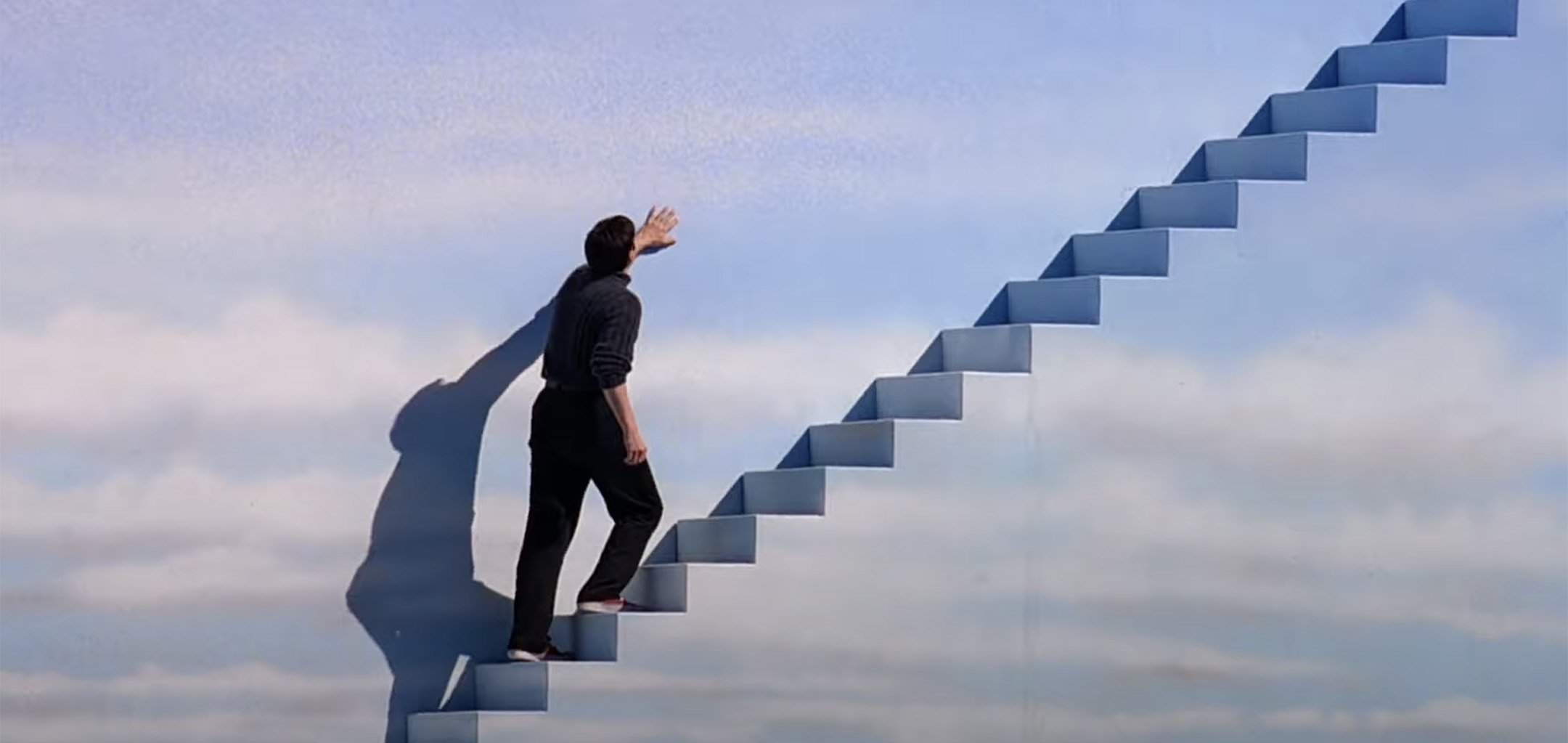
Near the start of The Truman Show, a stage light falls from the sky and lands at Truman’s feet. He looks up. Everyone around him pretends nothing happened. The radio explains it as debris from a passing aircraft. He almost believes it.
The whole film is the slow widening of his attention from that one small detail: the catch in his wife’s voice when she advertises kitchen products, the woman in the pink cardigan who circles past him every morning, the harbour he is not allowed to leave.
I have been thinking about that falling light a lot the past year.
Universities right now are full of small details that won’t quite go back into place. The student essay that arrives clean, fluent, hollow. The rubric that no longer seems to measure what it once claimed to. The marker who finishes a stack of papers and cannot, honestly, say what they read. Detection tools that fail at rates no responsible institution would accept in any other domain. Policies rewritten three times in eighteen months. Assessment redesigns that swap one control for another and call it innovation.
These are stage lights falling. And like Truman, we keep being handed temporary explanations and fixes and distractions in the shape of fancy new toys.
The story that needs to be told about generative AI in education is not that it broke the system. No. The system was already a soundstage; AI is just the boat.
There is a line earlier in the film that I keep returning to where a producer asks Christof how he has kept Truman inside the illusion for nearly thirty years without him ever seriously trying to leave. Christof answers:
We accept the reality of the world with which we are presented.
It is the most honest sentence in the film, and the most damning. It is also, when you sit with it, the inverse of what education has always claimed to be for. A liberal education, a critical education, a humanising education, or whatever vocabulary you prefer, is supposed to be the practice of not accepting the reality with which you are presented. Of asking who built it, who benefits, what it leaves out, what else is possible. The whole inheritance from Socrates to Freire rests on that refusal.
And yet the system that delivers this education at scale has been, for a long time now, an extraordinarily efficient training ground in acceptance. Submit by the deadline. Hit the word count. Meet the rubric. Earn the grade. Do not ask why this assignment, why this format, why this measure of your mind. Just… generate. Oh the irony.
My colleagues and I have been turning to self-determination theory, which Edward Deci and Richard Ryan have been refining since the 1980s, names three psychological needs that humans require for healthy motivation: autonomy, competence, and relatedness. When these are present, people learn because they want to.
When they are thwarted, people comply. Learning becomes performance. Performance becomes credential. Credential becomes the whole point.
You can describe most of mass higher education in those terms without straining. Students do not, in any deep sense, choose their assessments. At best, they just meet them. Competence is not felt but reported through marks. Relatedness is the relationship with a learning management system. The motivational architecture was always external regulation, dressed in the vocabulary of self-direction.
That dress was always thin. We just had reasons not to notice.
The reason institutional responses to AI keep landing flat is that they are still inside the dome. Better detection. Tighter rules. Securer exams. The problem is treated as a leak, a contamination, of an otherwise sound process.
Christof, the director of Truman’s world, has another chilling line.
I’ve given Truman the chance to lead a normal life. The world, the place you live in, is the sick place.
I keep hearing this echo in policy documents: The use of AI is misconduct. Students must demonstrate authentic skills. We are protecting the integrity of the qualification. The director still strongly believes his constructed world is the real one. The student who turns to AI is not exposing the set; they are spoiling it.
The cruellest illusion of the lot, I think, is the one that mostly goes unspoken: that students chose this. That they were autonomous learners exercising self-determination, and AI is corrupting an otherwise free engagement with knowledge. Self-determination theory is the wrong stick to beat AI use with, because if you take it seriously, the question stops being why are students outsourcing their work and becomes what kind of work, exactly, did we ever expect them to want?
A motivationally honest answer is uncomfortable. Much of what AI now does easily was the part students were already doing without curiosity, without ownership, without competence felt from the inside. The boat does not break the dome. It just stops pretending the painted horizon is the sea.
What lies outside, in the film, we never see. Truman walks through the door, bows, and the screen cuts to two security guards looking for something else to watch. Peter Weir is too careful to show us the world after the soundstage. Why? He knows there isn’t one ready.
Higher education is somewhere near that doorway now. Some of us are still adjusting the studio lights, calling for more sun. Some are looking for the staircase. Very few, honestly, know what the room outside the dome looks like, what it would mean to design a course in which autonomy was real, competence was felt, and relatedness was not the comments column on a Canvas page.
I do not know either. But I think the falling lights are not, in the end, bad news. They are simply asking a question the system has been refusing for a long time: what is this for, who is it for, and is the answer something we would be willing to say out loud.
Cue, eventually, an honest sun.
References
Ryan, R. M., & Deci, E. L. (2000). Self-determination theory and the facilitation of intrinsic motivation. American Psychologist, 55(1), 68–78.
Weir, P. (Dir.). (1998). The Truman Show. Paramount Pictures.
Image credit: Still from The Truman Show (1998)